
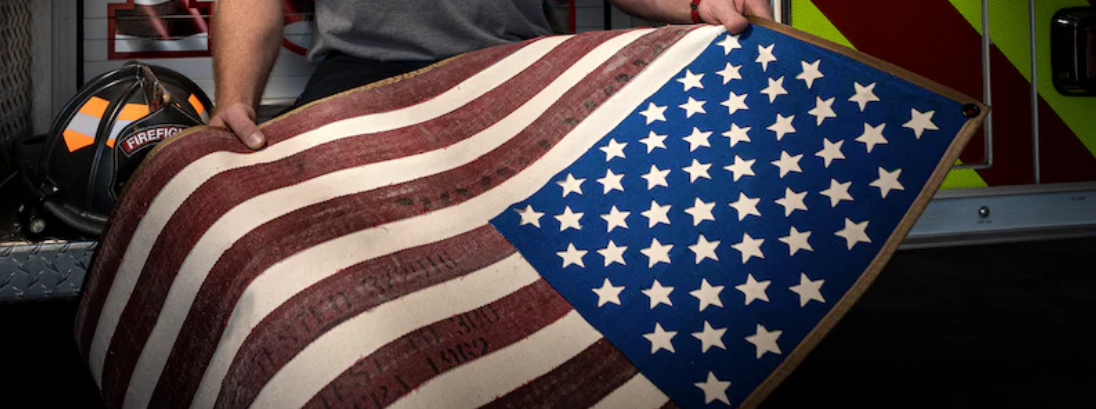
There's a Right Way to Retire an American Flag. It's Not the Fire Pit.
The Flag Code in plain English: when to fly it, how to hang it, and what to do with a worn one.
The short version
- The Flag Code is federal law, but its civilian display rules are generally advisory and carry no penalties. Think of them as national customs written down.
- Fly it sunrise to sunset. Overnight only if it's lit.
- Bad weather? Only an all-weather flag stays up.
- On a wall: stars top-left, as you look at it.
- A worn flag gets retired with dignity — preferably burned. But most flags are nylon now, and nylon shouldn't burn at home. Take it to a Legion post, VFW, or Scout unit.
- Indoors, out of the weather, a flag lasts. Condition decides when it's done, not location.
What the Flag Code is
It's Title 4, Chapter 1 of the U.S. Code (1). Congress adopted it in 1942 from etiquette hammered out at the Legion-led National Flag Conferences of 1923 and 1924 (2), and last amended it in December 2024.
Most civilian display and respect provisions are written as custom — they generally say the flag should, not must. The Congressional Research Service (3) describes those provisions as advisory and without a general enforcement mechanism.
When to fly it
Sunrise to sunset. That's the custom (1). Overnight is fine if the flag is properly lit — the Legion says a dedicated light is best (4), but anything bright enough that a passerby can see and recognize the flag counts.
Not in bad weather — unless it's an all-weather flag. Section 6(c) (1). The Code doesn't define "all-weather." The American Legion identifies nylon and other non-absorbent materials as all-weather, but check the flag's label or manufacturer instructions.
Every day you can. The Code lists the big ones (1): Flag Day, July 4, Memorial Day, Veterans Day — but says the flag should fly on all days. The list is emphasis, not a limit.
Up briskly, down slowly. Section 6(b).
How to position it
Stars top-left, as you face it. On a wall, horizontal or vertical, the union goes uppermost and to the flag's own right (1) — your left. In a window, judge the orientation from the street: the union belongs at the observer's left.
Never upside down — except as a distress signal. Section 8(a) (1).

American Flag - Fire Hose & Arid Border
Position of honor. With state or organizational flags: U.S. flag at the peak (1) of a shared halyard, first up and last down on separate staffs, nothing above it or to its right. Flags of other nations are different — equal staffs, equal height, roughly equal size.
Half-staff follows an official order or a date set by law. An official order (1) may come from the President, a governor, or the mayor of Washington, D.C. Some observances, including Memorial Day until noon, are set by law.
Verify the instruction against an official federal, state, territorial, or D.C. proclamation. Hoist to the peak first, then lower. Raise it to the peak again before taking it down. Memorial Day: half-staff until noon, then up.
What it should never be
Section 8 (1), the ones that come up:
- Touching anything beneath it — the ground, the floor, water, or merchandise. (Touched the ground? Clean it. That's a myth about having to destroy it.)
- Cut into clothing, bedding, or drapery. A flag-print shirt is fine — this is about an actual flag.
- Marked with anything. (If you've seen our flags, you might be wondering about this one. We'll get to it.)
- Used in advertising, or printed on anything meant to be thrown away.
- Stored where it can get torn or soiled.
When it's done, and what to do
Section 8(k) (1): when a flag is no longer a fitting emblem for display, destroy it in a dignified way, preferably by burning.
"Fitting" is your call. Heavy fading, fraying, tears, permanent stains — those are the signs. Washing and small repairs are fine; nothing in the Code says otherwise (5).

Here's the catch. Most U.S. flags today are nylon or polyester (4), and the American Legion says those materials are difficult to dispose of by burning and can release harmful gases — a concern it says the EPA shares. Burying doesn't help either; the material doesn't break down. Scouting America's guidance (6) says the same about nylon.
So don't burn a synthetic flag at home. Hand it off:
- American Legion posts — many conduct retirement ceremonies (7) around Flag Day; ask your local post whether it accepts flags throughout the year.
- VFW posts — some have a drop box (8).
- Scout units — some Scout units conduct flag-retirement service projects.
- Town hall or the fire station — some keep a collection box.
Call first; what they accept and how they handle synthetics varies. Folding it into the triangle is a courtesy, not a rule (9).
What this looks like when a community gets it right
A Rockaway Park sanitation worker started pulling flags out of the trash on his route. By 2014 he'd saved more than 700 (10), many wrecked by Superstorm Sandy, and had them retired at the Merchant Marine Academy.
In 2018, CBS reported that Grapevine, Texas, had converted an old mailbox into a flag drop box at Fire Station 1 (11). A Scout troop emptied it when full, usually about once a month, and conducted the retirement ceremony. That box has since been removed; the city now directs residents to a drop-off receptacle at VFW Post 10545 (12).

American Flag - Fire Hose - Thin Red Line
Chicago retired 7,000 flags on one Flag Day (13) in 2012, collected from city buildings and drop boxes.
None of those people had to figure out the Code alone. They had somewhere to bring the flag. Find yours before you need it.
So what about our flags?
Fair question. You just read "marked with anything." Some of ours carry markings.
Here's the thing. On our classic American flag, we don't add anything. Any marking you see was on the hose first.
Every one starts as decommissioned fire hose, and no two lengths are alike. Depending on which section we cut, you might see a city or department name. You might see nothing. Some hose served, and it shows. Some was retired before it ever saw a call. Either way, we pulled it out of the waste stream. We don't hide where it came from. That's the point.

American Flag - Fire Hose - Second Amendment
Some of our other designs are a different thing. The Second Amendment flag, the Thin Red Line, and the Thin Blue Line are deliberate. The text and the stripe are there because we put them there. Those aren't the flag as the Code defines it, which is thirteen stripes and fifty stars with nothing added. They're wall art in the shape of the flag, and we don't call them anything else. If you want the flag the Code was written for, the classic is that one, with only the hose's own history on it.
None of ours are regulation flags, and none are built to fly. They're built to hang on a wall and carry the story of the hose that made them.
Some flag purists will still disagree. We respect that. People who take the flag seriously don't always agree on the details. We'd rather have that conversation than dodge it.
The flag that stays out of the weather
Outdoor flags usually reach the end of their service life sooner. The Legion says sun, wind, rain, and snow can shorten a flag's life considerably (14). An indoor flag avoids most of that exposure, although Section 8(k) (1) still applies if it eventually becomes unfit for display. Condition is the test, not location, but indoor display usually means less exposure and a longer service life.

That's the idea behind our fire hose flags. Each one is wall art made from real 5-inch decommissioned fire hose, with heavy 30-ounce cotton-canvas backing and brass grommets for hanging. Cut, assembled, and sewn in small batches in our Cape Coral, FL shop. Built for a garage, a firehouse, a den, or an office — not a pole. It hangs instead of flies. Stars top-left, same as any other.
Want a flag to fly? Buy a good all-weather one and follow the rules above. Want one to keep on the wall? That's ours.
Frequently Asked Questions
-
Can I fly the flag at night?
Yes, if it's properly lit (1). -
Do I have to destroy a flag that touched the ground?
No. Clean it and keep using it (5) if it's still fit for display. -
Is it illegal to break the Flag Code?
The civilian display and respect rules are generally advisory (3) and have no general enforcement mechanism. -
Can I burn a worn flag myself?
Don't burn a nylon or polyester flag at home. Synthetic flags are difficult to burn and can release harmful gases (4). Contact a Legion post, VFW, Scout unit, or another local collection program and ask how it handles synthetic material. -
Which way does the flag hang on a wall?
Stars at the top, on your left. Same rule (1) horizontal or vertical.
References
- The Flag, 4 U.S.C. §§ 1–10 (2024). https://www.govinfo.gov/content/pkg/USCODE-2024-title4/pdf/USCODE-2024-title4-chap1.pdf
- The American Legion. (n.d.-a). History. https://www.legion.org/about/organization/history
- Thomas, K. R. (2019). Frequently asked questions about flag law (CRS Report No. R45945). Congressional Research Service. https://www.congress.gov/crs-product/R45945
- The American Legion. (n.d.-b). U.S. flag myths, FAQs, & terminology. https://www.legion.org/advocacy/flag-advocacy/frequently-asked-questions
- American Legion Post 778. (n.d.). Flag frequently asked questions (FAQs). https://legionpost778.org/american-legion-information/flag-faqs/
- Boy Scouts of America. (2020). Interest topic: Flag ceremonies [Cub Scout roundtable guide]. https://www.scouting.org/wp-content/uploads/2020/02/Flag-Ceremonies-2019_Rev.03.01.2020.pdf
- The American Legion. (n.d.-c). Unserviceable flags ceremony. https://www.legion.org/advocacy/flag-advocacy/unserviceable-flags-ceremony
- Veterans of Foreign Wars of the United States. (n.d.). Flag etiquette. https://www.vfw.org/community/flag-etiquette
- The American Legion. (n.d.-d). U.S. Flag Code: Display, respect & proper use. https://www.legion.org/advocacy/flag-advocacy/flag-code
- New York sanitation worker saves American flags from the garbage heap. (2014). Fox News. https://www.foxnews.com/us/new-york-sanitation-worker-saves-american-flags-from-the-garbage-heap
- Disposal ‘mailbox’ in Grapevine makes retiring American flag easy. (2018, June 14). CBS News Texas. https://www.cbsnews.com/texas/news/disposal-mailbox-in-grapevine-makes-retiring-american-flag-easy/
- City of Grapevine. (n.d.). Fire stations. https://www.grapevinetexas.gov/707/Fire-Stations
- 7,000 aging U.S. flags ‘retired’ in Flag Day ceremony. (2012, June 14). CBS News Chicago. https://www.cbsnews.com/chicago/news/7000-u-s-flags-burned-in-flag-day-retirement-ceremony/
- American Legion Flag & Emblem. (n.d.). How to care for a flag. https://emblem.legion.org/flag-education/care.asp


Leave a comment
This site is protected by hCaptcha and the hCaptcha Privacy Policy and Terms of Service apply.